
Rotate the device
In the creation of mould components, precision and optimal resource management are essential to remain competitive.
MES (Manufacturing Execution Systems) stand out as fundamental tools for monitoring working hours, providing valuable data that extends beyond a single project and directly influences future planning and quoting processes.
At Giurgola Stampi, implementing MES has revolutionized decision-making, making it more data-driven. Each hour of work logged is not just a number but a crucial piece that builds a more efficient and predictive strategy for manufacturing new moulds.
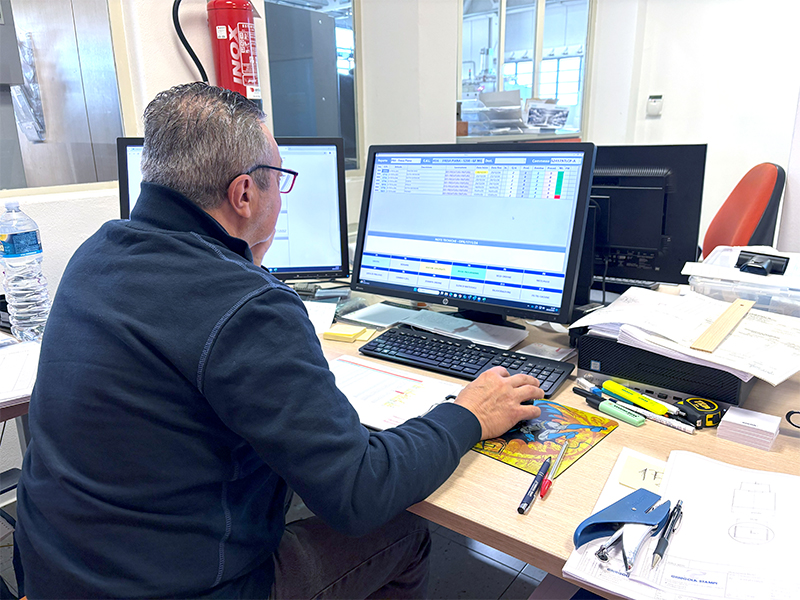
MES precisely records the working hours of each mould component, from precision milling to EDM operations and final assembly. This data is critical for analyzing the efficiency of each production phase and creating a detailed timeline of the steps required to complete a complex mould.
Riccardo, head of programming, explains: “Knowing exactly how long each phase takes allows us to plan with greater accuracy. If we need to manufacture a similar mould, we can use MES data to estimate delivery times and optimally allocate workloads across machines and departments.”
With continuous monitoring, MES not only tracks working hours but also identifies potential delays and bottlenecks, enabling immediate action to keep production flowing smoothly and deadlines on track.
When it comes to quoting a new mould, accuracy is everything. Historical data provided by MES enables precise calculation of the time required for each production phase, transforming this information into realistic and competitive quotes.
“In the past, we relied solely on experience and estimates,” says the head of sales. “Now, we can base our quotes on hard data: we know how many hours were required for a similar mould, what challenges we faced, and how we can optimize the process for the new project. This gives us a competitive edge because our clients receive clear and reliable quotes.”
This approach reduces the risks of underestimations or overestimations, improving client trust and ensuring that every project remains economically sustainable for the company.
One of the most revolutionary aspects of MES is its ability to turn collected data into predictive insights. By comparing recorded working hours for similar projects, recurring patterns can be identified, continuously improving production processes.
“The data from MES helps us not only plan for the future but also identify opportunities for improvement,” says a team lead. “For instance, if we notice that a specific production phase consistently takes longer than expected, we can focus on optimizing that phase.”
This predictive approach is not limited to individual production cycles but becomes a strategic element for the entire business, ensuring continuous performance improvement.
MES is more than just a monitoring system; it is a compass that guides every aspect of mould component production. From recorded working hours come more accurate planning, reliable quoting, and optimized production strategies.
For companies like Giurgola Stampi, operating in a sector where every detail matters, MES is an indispensable source of knowledge and precision. With these tools, every project becomes not just a challenge but an opportunity to grow, improve, and anticipate customer needs.