
Rotate the device
Mould and Integrated Automation: The Key to Competitiveness in 2025
In the world of injection moulding, 2025 marks a paradigm shift: the mould is no longer a stand-alone component, but the beating heart of an industrial ecosystem focused on productivity, repeatability, and smart automation.
At Giurgola Stampi, we see it every day: customers no longer ask for a mould that simply works, but for a system-ready solution—integrated, high-performing, and optimized for continuous flow, fast cycles, and zero waste.
According to data from the Statista – Pharmaceutical Packaging Report 2023 and sector insights from MacPlas, the integration between the mould, the injection machine, and downstream automation is now a critical competitive factor, especially in the following industries:
Pharmaceutical and Medical: where the production cycle must ensure maximum hygiene, traceability, and reliability.
Cosmetics: where the aesthetic and functional quality of packaging must meet high-volume demand.
Food: where repeatability and food-grade safety are under continuous regulatory scrutiny.
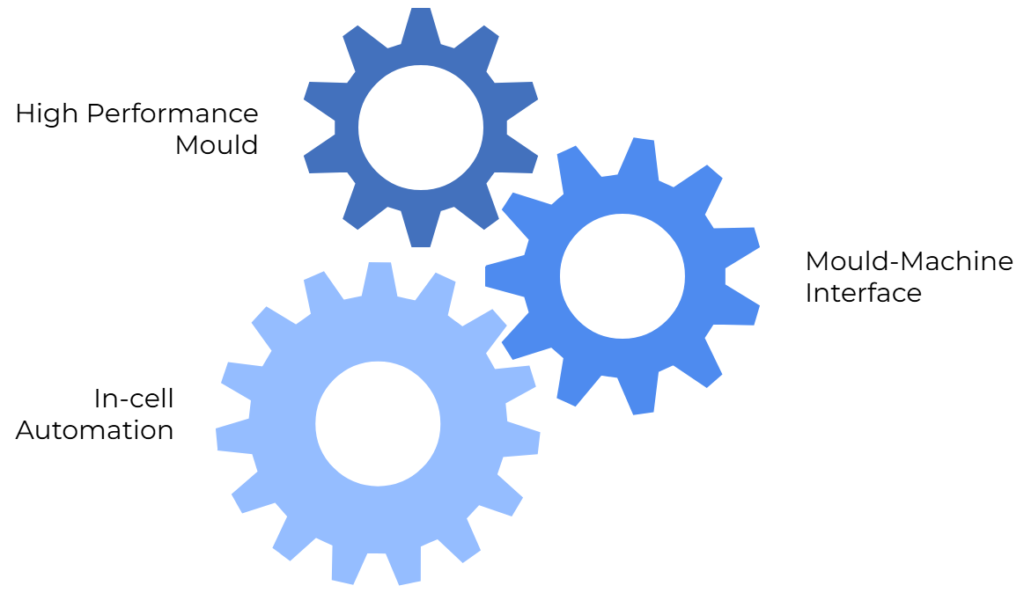
In practice, integrated automation means designing three core components in a coordinated way:
High-performance moulds: engineered with complex geometries, balanced designs, and wear-resistant materials.
Optimized mould-machine interface: minimizing idle time between cycles and maximizing overall efficiency.
In-cell automation: robotic extraction, automatic assembly devices, in-line functional tests, and vision systems for quality control.
All of these must be developed in parallel during the mould design phase—a technical challenge and a strategic advantage.
Co-design with the customer is essential.
Only by integrating production line requirements with mould engineering from the beginning can tangible results be achieved:
Competitive cycle times (below 6 seconds in some applications)
Reduced rework and adjustments
Greater process stability
This collaborative approach is a consolidated practice at Giurgola Stampi, made possible through continuous technical dialogue with our clients and the use of advanced simulation tools—flow analysis, tolerance mapping, and thermal balance optimization.
A recent internal market analysis shows that mould-automation integration is already a standard in the following sectors:
Medical – Pharma: for high-security disposable caps and components
Cosmetics: for flip-top closures and packaging requiring high-end aesthetic finishes
Personal & Body Care: especially for dosing closures, push-pull caps, and dispenser systems
The most forward-thinking players in these industries stand out by offering turnkey solutions—where the mould is not a standalone tool, but a key part of the automated production system.
In 2025, competitiveness isn’t just about cavity count, materials, or dimensional precision.
It’s about designing moulds as part of a smart, integrated, connected manufacturing system.
Giurgola Stampi has long chosen this path, investing in advanced design, technical partnerships, and ongoing collaboration with its customers.
For us, it’s not just about building moulds—it’s about generating shared value in the name of efficiency, safety, and sustainability.
Get in touch to discover how we can support your production with tailor-made solutions—ready for 4.0 integration.